
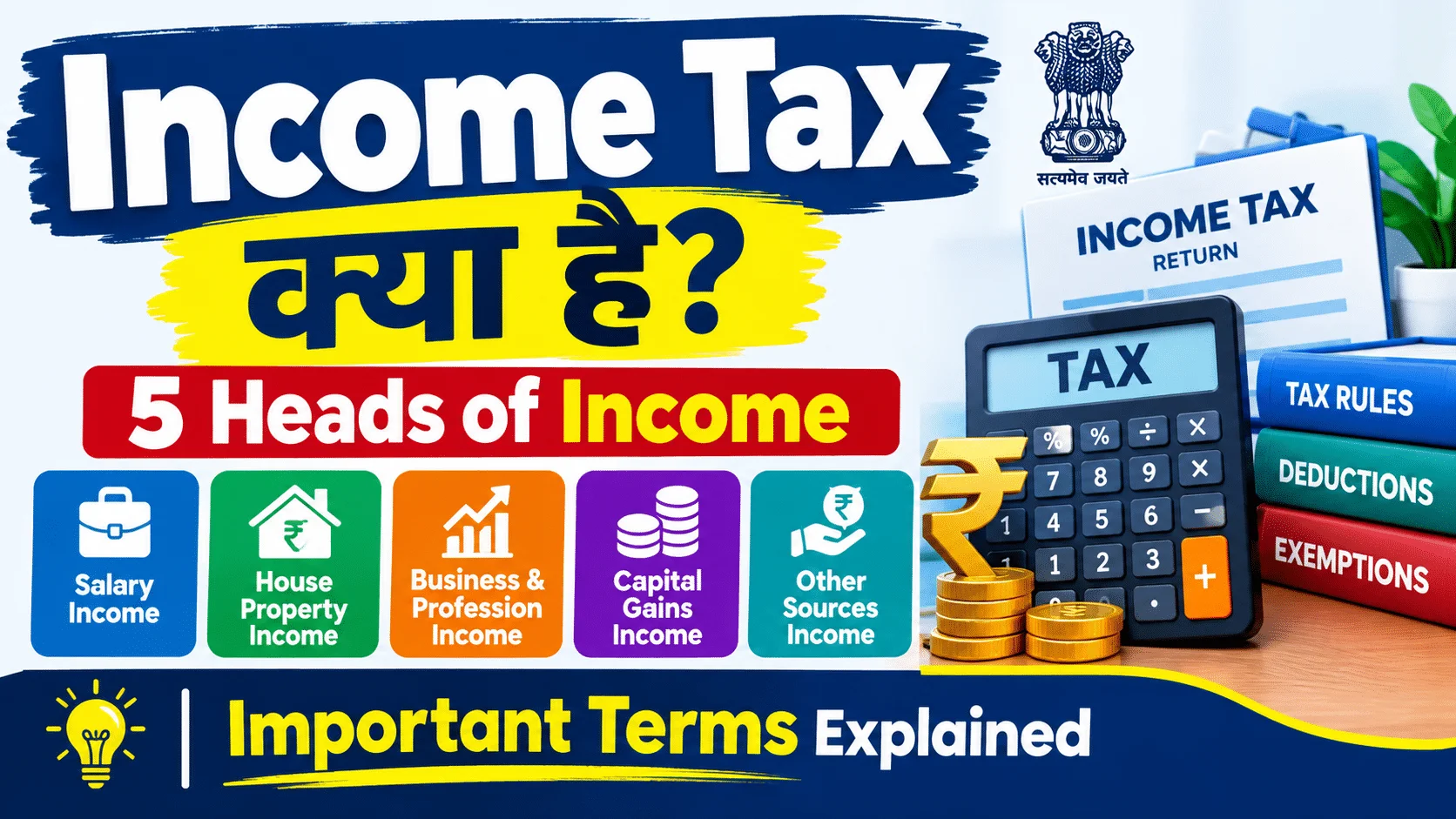

Income Tax ek direct tax hai jo India mein kisi person ya business ki taxable income par lagta hai. Income Tax ko achhe se samajhne ke liye pehle ye jaana zaroori hai ki income kya hoti hai, usmein se taxable income kaise calculate ki jaati hai, aur Income Tax ke different Heads of Income ke under income ko kaise divide kiya jata hai.
Is Article mein hum Income Tax, Taxpayer, Assessment Year, Tax Year, Gross Total Income, Total Income, Exemption, Deduction, TDS, Advance Tax, PAN, ITR aur 5 Heads of Income ko Simple language mein Samjhenge.
What is Income Tax?
Income Tax ek Direct Tax hai, jo taxpayers apni taxable income ke basis par Government ko pay karte hain.
Simple words mein:
Agar kisi person ki taxable income applicable tax Rules ke According taxable limit ke above hai, to us par Applicable Tax liability ho sakti hai.
Example
Arman ko salary se income milti hai aur bank deposit par interest bhi receive hota hai. Income Tax Rules ke according, in dono sources se hone wali income ko consider karke uski taxable income calculate ki ja sakti hai.
Important: Taxable income sirf total received money par depend nahi karti. Applicable exemptions, deductions, selected tax regime aur other tax provisions bhi calculation ko affect karte hain.

What is Direct Tax?
Income Tax ko Direct Tax kehte hain, kyunki yeh tax taxpayers apni taxable income ke basis par directly Government ko pay karte hain.
Direct tax mein tax ka burden generally usi taxpayer par hota hai jiske Income /Transaction Par Tax imposed hai.
Example
Agar kisi individual ki taxable income calculate karne ke baad ₹20,000 ki tax liability banti hai, toh applicable tax rules, exemptions aur tax credits ko consider karne ke baad us individual ko payable tax jama karna hota hai.
What is income?
Income ka meaning sirf Salary nahi hai.
Different sources se income ya taxable receipts mil sakti hain, jaise:
- Salary
- House Property income
- Business/Profession income
- Capital Gains
- Interest
- Certain other income
Income Tax calculate karne ke liye income ko applicable Heads of Income ke under classify kiya jata hai, jisse har type ki income par tax rules sahi tarike se apply kiye ja sakein.

What are the heads of Income?
India mein Income Tax calculate karne ke liye income ko generally 5 Heads of Income mein classify kiya jata hai, aur har head par applicable tax rules ke according calculation ki jaati hai.
Five Heads of Income:
- Income from Salary
- Income from House Property
- Profits and Gains of Business or Profession
- Capital Gains
- Income from Other Sources
Income ko sahi Head of Income ke under classify karna, applicable tax rules apply karne aur Taxable Income accurately calculate karne ke liye zaroori hai.
Income from Salary
Agar Employee ko Employer se Salary, Wages, Pension ya applicable salary-related benefits milte hain, to Applicable Provisions ke according ye Income Salary head mein Taxable ho sakti hai.
What can be included in the salary?
- Basic Salary
- Dearness Allowance
- Bonus
- Commission
- Taxable Allowances
- Perquisites
- Pension, where applicable
Example
Arman ek company mein job karta hai aur use har mahine salary milti hai. Income Tax Rules ke according, uski salary se hone wali income ko Income from Salary ke under classify kiya ja sakta hai, agar applicable conditions fulfil hoti hain.Monthly salary = ₹50,000
Annual salary = ₹50,000 × 12
= ₹6,00,000
Arman ki actual taxable salary calculate karte waqt applicable exemptions, deductions aur Income Tax Rules ke other provisions ko consider kiya jata hai.
Income from House Property
Agar kisi taxpayer ke paas house property hai, to usse hone wali rental income ya applicable deemed income ko Income Tax Rules ke according Income from House Property ke under calculate kiya ja sakta hai.
Example
Arman ne apna house Rent Par diya.
Monthly rent = ₹20,000
Annual rent = 20,000*12 = ₹2,40,000
House Property se hone wali income ko applicable Income Tax Rules, deductions aur other provisions ko consider karke calculate kiya jata hai.
Important
House Property ki taxable income calculate karte waqt sirf actual rent ko consider nahi kiya jata. Applicable deductions, property ki annual value aur other Income Tax provisions ko bhi dhyan mein rakha jata hai.
Profits and Gains of Business or Profession
Business ya profession se hone wali taxable income ko applicable Income Tax Rules ke according Profits and Gains of Business or Profession (PGBP) ke head ke under classify kiya jata hai.
Examples
- Shop business
- Trading business
- Consultancy
- Professional services
- Manufacturing
- Freelancing/Professional Activity, Depending on Applicable Provisions
Example
Arman ki business ki:
Sales/Receipts = ₹10,00,000
Allowable Business expenses = ₹6,00,000
Basic Business Profit = ₹4,00,000
Actual taxable business income applicable tax provisions ke according determine ki jayegi.
Capital Gains
Kisi Capital Asset ko transfer karne se jo Gain/loss arise hota hai, woh applicable Conditions ke according Capital Gains ke under taxable ho sakta hai.
Examples
- Land
- Building
- Shares
- Securities
- Certain other capital assets
Example
Maan lijiye, aapne ek asset ₹5,00,000 mein kharida aur baad mein applicable Income Tax Rules ke according use ₹8,00,000 mein transfer kiya. Conditions fulfil hone par ₹3,00,000 ka profit Capital Gains ke under taxable ho sakta hai.
Basic difference:
₹8,00,000 − ₹5,00,000
= ₹3,00,000
Actual Capital Gain calculation mein applicable cost, expenses, exemptions, and other tax Provisions Consider kiye ja sakte hain.
Income from Other Sources
Jo income kisi specific head mein taxable nahi hai, woh applicable provisions ke according Income from Other Sources ke under aa sakti hai.
Common Examples
- Bank Interest
- Fixed Deposit Interest
- Certain dividend income
- Certain other taxable receipts
Example
ARMAN ko FD se Annual interest ₹40,000 mila.
Bank interest, dividend ya kisi other source se milne wali income ko applicable Income Tax Rules ke according Income from Other Sources ke under taxable maana ja sakta hai.
What is Gross Total Income (GTI)?
Different Applicable heads se calculated income ko aggregate karne ke baad, Chapter VI-A deductions ko consider karne se pehle jo amount aata hai, use generally Gross Total Income (GTI) kaha jata hai.
Simple flow:
Salary Income
- House Property Income
- Business/Profession Income
- Capital Gains
- Other Sources Income
Applicable set-off rules aur other provisions ko consider karne ke baad, different heads of income se calculate ki gayi income ka total Gross Total Income (GTI) kehlata hai.
What is total income?
Gross Total Income (GTI) mein se applicable deductions ko subtract karne ke baad jo amount milta hai, use Total Income kaha jata hai. Isi amount ke basis par applicable tax rules ke according Income Tax calculate kiya jata hai.
Simple Example
Gross Total Income = ₹8,00,000
Eligible deductions = ₹1,00,000
Total Income = ₹7,00,000
Actual Calculation applicable tax laws aur Taxpayer ke Dircumstances ke according hoti hai.
What is taxable income?
Taxable Income woh amount hota hai jo applicable deductions, exemptions aur Income Tax provisions ko consider karne ke baad determine kiya jata hai. Isi ke basis par applicable tax rates aur rules ke according tax liability calculate hoti hai.
Taxable income calculate karte waqt:
- Income
- Exemptions
- Deductions
- Loss adjustment
- Applicable tax provisions
Jaise factors Relevant ho sakte hain.
What is an exemption?
Exemption ka matlab hai ki applicable Income Tax Rules ke under, specified conditions fulfil hone par kuch income ya uska ek hissa tax se exempt ho sakta hai.
Example
Kuch Specified Allowances/income ko applicable conditions fulfill hone par exemption mil sakti hai.
Important: Har Allowance Automatically tax-free nahi hota. Exemption ke liye Applicable Conditions check karna zaroori hai.
What is a deduction?
Deduction Eligible income se Specified Amount Reduce karne ki facility hoti hai, Subject to Applicable Conditions.
For example, Income Tax law ke under Certain eligible investments/payments par specified deductions available ho sakti hain.
Simple Example
Gross Total Income = ₹7,00,000
Eligible deduction = ₹50,000
Then:
₹7,00,000 − ₹50,000
= ₹6,50,000
Applicable tax Calculation Rules ke according hogi.
What is PAN?
PAN = Permanent Account Number
PAN ek unique identification number hai jo Income Tax-related transactions aur compliance mein important role play karta hai.
PAN ka use commonly:
- Income Tax Return filing
- Tax-related transactions
- TDS-related records
- Financial transactions
Mein hota hai.
What is TAN?
TAN = Tax Deduction and Collection Account Number
TAN generally un persons/entities ke liye Relevant hota hai jo applicable provisions ke according TDS/TCS deduct ya collect karte hain.
What is TDS?
TDS = Tax Deducted at Source
TDS System mein Specified Payment karte waqt, Applicable Conditions ke according Payer Payment ka Certain Amount tax ke form mein deduct karke Government ko Deposit karta hai.
Example
Agar kisi payment par TDS applicable hai, to payer Applicable Rate ke according TDS deduct kar sakta hai.
Recipient ko TDS ka Credit Applicable Conditions ke Cccording mil sakta hai.
What is TCS?
TCS = Tax Collected at Source
Certain specified transactions mein seller/collector applicable provisions ke according buyer se tax collect karke Government ko Deposit karta hai.
TCS Provisions Transaction aur Applicable law par depend karte hain.
What is Advance Tax?
Agar taxpayer ki estimated tax liability applicable threshold aur conditions ko meet karti hai, to tax ko year ke during installments mein advance mein pay karna pad sakta hai.
Isse Advance Tax kaha jata hai.
Simple Concept
Instead of paying the entire applicable tax at the end:
Year ke during → Tax installments
What is Self-Assessment Tax?
ITR file karne se pehle agar taxpayer ki tax liability mein koi amount payable remain karta hai, to applicable conditions ke according taxpayer Self-Assessment Tax pay kar sakta hai.
What is Assessment Year (AY)?
Traditional Indian Income Tax terminology mein Assessment Year woh period hai jisme previous year’s income ka assessment/tax return related process hota hai.
Example:
FY 2025-26 → AY 2026-27
What is Financial Year (FY)?
Financial Year generally 1 April se 31 March tak ka period hota hai.
Example:
1 April 2025 to 31 March 2026 = FY 2025-26
Isi period mein earn ki gayi income applicable tax provisions ke according calculate ki jati hai.
What is Tax Year?
Current Income Tax framework mein Tax Year terminology bhi relevant hai. Tax Year generally 1 April se 31 March ka 12-month period hai, aur ye us financial year ke start se begin hota hai.
Tax Year terminology ko samajhna especially new tax-law framework ke context mein important hai.
What is Previous Year?
Traditional Income Tax terminology mein Previous Year (PY) woh financial year hota hai jisme income earn ki jati hai.
Example:
Income earned during:
1 April 2025 – 31 March 2026
= Previous Year / FY 2025-26
Is income ka assessment traditional terminology mein AY 2026-27 se linked hota hai.
What is ITR?
ITR = Income Tax Return
ITR ek tax Return hai jisme Taxpayer apni applicable:
- Income
- Deductions
- Tax paid
- TDS
- Tax liability
- Refund
Etc. ki Details Report karta hai.
Different taxpayers aur income situations ke liye different ITR forms applicable ho sakte hain.
What is Income Tax Slab?
Income Tax Slab ka meaning hai different income ranges par applicable tax rates ka structure.
Tax rate taxpayer ki:
- Income
- Tax regime
- Residential status
- Age/category where relevant
- Nature of income
- Applicable deductions/exemptions
jaise factors par depend kar sakta hai.
Important: Tax slabs change ho sakte hain, isliye tax calculation karte waqt current financial/tax year ke official rules check karne chahiye.
What is Tax Regime?
Taxpayer ke liye applicable tax calculation system ko broadly Tax Regime kaha jata hai.
India mein tax calculation ke context mein New Tax Regime aur specified conditions ke under Old Tax Regime relevant hain.
Dono regimes mein deductions/exemptions aur tax rates ka treatment different ho sakta hai.
What is a Taxpayer?
Taxpayer woh person/entity hai jo Income Tax law ke according tax ke liye liable ho sakta hai.
Taxpayer mein applicable circumstances ke according:
- Individual
- HUF
- Firm
- Company
- LLP
- Association
- Other persons/entities
include ho sakte hain.
Financial Year aur Assessment Year ka Difference
| Term | Simple Meaning |
|---|---|
| Financial Year | Jis period mein income earn hoti hai |
| Previous Year | Traditional terminology mein income earn karne wala year |
| Assessment Year | Traditional terminology mein us income ke assessment/return se related next year |
| Tax Year | Current framework mein relevant 12-month tax period |
Example
FY 2025-26 → AY 2026-27
Current tax-law framework mein applicable Tax Year terminology ko bhi consider karna chahiye.
Income Tax Calculation Basic Flow
Income Tax Calculation ko Simple way mein Samjhein:
Different Sources of Income
↓
5 Heads of Income
↓
Applicable Income/Loss Adjustment
↓
Gross Total Income
↓
Eligible Deductions
↓
Total Income
↓
Applicable Tax Rate/Slabs
↓
Tax Liability
↓
Less: Applicable Tax Credits/TDS, etc.
↓
Tax Payable / Refund
Actual computation taxpayer ki specific situation aur current tax provisions par depend karti hai.

Practical Example – Multiple Sources of Income
Suppose Rahul ki income sources hain:
- Salary = ₹6,00,000
- House Property Income = ₹1,20,000
- Bank Interest = ₹30,000
To different income sources ko applicable heads ke under classify kiya jayega.
Salary → Income from Salary
House Property → Income from House Property
Bank Interest → Income from Other Sources
Uske baad applicable provisions ke according total income calculate ki jayegi.
Important Income Tax Terms – Quick Revision
| Term | Full Form / Meaning |
|---|---|
| PAN | Permanent Account Number |
| TAN | Tax Deduction and Collection Account Number |
| TDS | Tax Deducted at Source |
| TCS | Tax Collected at Source |
| ITR | Income Tax Return |
| FY | Financial Year |
| AY | Assessment Year |
| GTI | Gross Total Income |
| Total Income | Deductions ke baad applicable taxable income |
| Taxpayer | Tax law ke under relevant person/entity |
| Capital Gain | Capital asset transfer se applicable gain |
| Deduction | Eligible income se specified reduction |
| Exemption | Specified conditions ke under tax exemption |
| Advance Tax | Year ke during applicable advance tax payment |
Important Tips
Income Tax samajhte waqt ye points yaad rakhein:
- Salary hi income ka only source nahi hai.
- Income ko applicable 5 Heads of Income mein classify kiya jata hai.
- Exemption aur deduction same nahi hote.
- TDS aur final tax liability same concept nahi hain.
- PAN tax-related identification ke liye important hai.
- ITR mein applicable income aur tax details report ki jati hain.
- Tax rules, rates aur provisions change ho sakte hain.
- Tax calculation ke liye current applicable rules verify karna important hai.
Frequently Asked Questions (FAQs)
Q1. Income Tax Kya Hai?
Income Tax ek direct tax hai jo applicable tax laws ke according taxable income par impose hota hai.
Q2. Income Tax mein kitne Heads of Income hain?
Generally, income ko 5 Heads mein classify kiya jata hai:
- Salary
- House Property
- Business/Profession
- Capital Gains
- Other Sources
Q3. Salary kis head mein aati hai?
Applicable conditions ke according, salary income Income from Salary head mein taxable hoti hai.
Q4. Bank Interest kis head mein aata hai?
Generally, taxable bank interest Income from Other Sources ke under aa sakta hai, Subject to applicable provisions.
Q5. PAN ka full form kya hai?
PAN ka full form Permanent Account Number hai.
Q6. TDS ka full form kya hai?
TDS ka full form Tax Deducted at Source hai.
Q7. ITR ka full form kya hai?
ITR ka full form Income Tax Return hai.
Q8. Gross Total Income kya hoti hai?
Applicable income heads ko consider karke deductions se pehle determine ki gayi income ko broadly Gross Total Income kaha jata hai.
Q9. Financial Year kya hota hai?
Financial Year generally 1 April se 31 March tak ka period hota hai.
Q10. Kya Income Tax rules change ho sakte hain?
Haan. Tax rates, limits, deductions aur other provisions change ho sakte hain. Isliye current tax year ke applicable rules check karna important hai.
Educational Disclaimer:
Yeh article sirf educational purpose ke liye hai. Income Tax rules, rates, deductions, exemptions aur other provisions time to time change ho sakte hain. Actual tax calculation ya filing se pehle current provisions ko official Income Tax Department sources se verify karein ya qualified tax professional se advice lein.


